Participating in the NYC YA50 Summit, GFLP Advocates for Environmental Solutions Through Visual Media


The Climate! Film! Action! The Youth Environmental Media Program, initiated by LJM’s Global Family for Love and Peace (GFLP), has been selected by the New York City government as a key capacity-building organization for the Youth Action 50 (YA50) initiative. To support YA50 members, the city has curated a series of empowerment and exchange pathways. Among these, the annual summit serves as a vital platform for showcasing the achievements of the 50 participating community organizations. Through expert feedback from government sectors and public dialogue, the summit enables youth perspectives to bridge into policy discussions and the broader scope of public decision-making.
At the Youth Action 50 Summit in early May, members of the "Climate! Film! Action!" project explored the theme of "Pollution" through a multi-dimensional lens. Their investigations spanned from mental landscapes and public space litter to air quality and the vital contributions of informal community waste picking systems to resource recovery. Furthermore, they examined grassroots initiatives like the Billion Oyster Project, observing how oyster reef restoration serves as a practical model for rehabilitating aquatic ecosystems.
Beyond addressing traditional environmental degradation, members further observed that pollution is reshaping both our quality of life and holistic well-being. As public spaces shrink and natural sanctuaries are increasingly supplanted by commercial venues, the areas where people can freely linger, reflect, and find emotional equilibrium are diminishing. This loss negatively impacts mental health, giving rise to a subtle yet pervasive form of "mental pollution." With May being National Mental Health Awareness Month, presenting these findings now underscores a vital truth: pollution affects not only our physical surroundings but also our internal state, calling for a more profound public discourse on the intersection of environment and mind.
At the summit, "Climate! Film! Action!" participants showcased five short films centered on the theme of pollution. Through interactive display boards, they shared the creative inspiration and context behind each work. By combining documentary footage with evocative photography, the students illustrated urban dynamics and environmental phenomena, effectively mapping the symbiotic relationship between humanity and nature. This approach allowed attendees to engage with abstract issues through grounded, tangible scenarios, sparking meaningful dialogue and transforming the environmental insights of the new generation into a potent force for civic action.
From Corporate Accountability to Community Engagement: Environmental Advocacy Gains Recognition
Officials from the New York City Department of Sanitation engaged with the participants to explore their perspectives on pollution issues. Waverly, a high school student, used a potato chip bag as a compelling example, arguing that manufacturers must bear environmental accountability for the low-cost convenience they provide. Representing the group, she proposed that environmental policies should integrate community engagement frameworks, establishing bidirectional communication channels tailored to localized issues—such as flooding or noise pollution—to ensure a precise response to local needs. Impressed by these nuanced insights, the officials requested copies of the films for internal reference and encouraged the members to participate in the Youth Climate Summit, continuing to leverage visual media to catalyze public environmental awareness.
Reclaiming the Vanished "Third Space": Reconnecting Humanity Through the "Walking Under the Moon" Initiative
An audience member originally from Montana—a state renowned for its pristine, untamed landscapes—was deeply resonated by Sydney’s film, "What the Town Mouse Needs." The work, which explores the loss of the "Third Space," prompted him to share his own experience: moving to New York meant being severed from nature’s embrace. Far from the grounding presence of greenery, he found it increasingly difficult to feel at ease, describing a persistent inner tension and a loss of grounding. His poignant reflection mirrored a universal struggle in modern urban life—the growing alienation between humanity and the natural world.
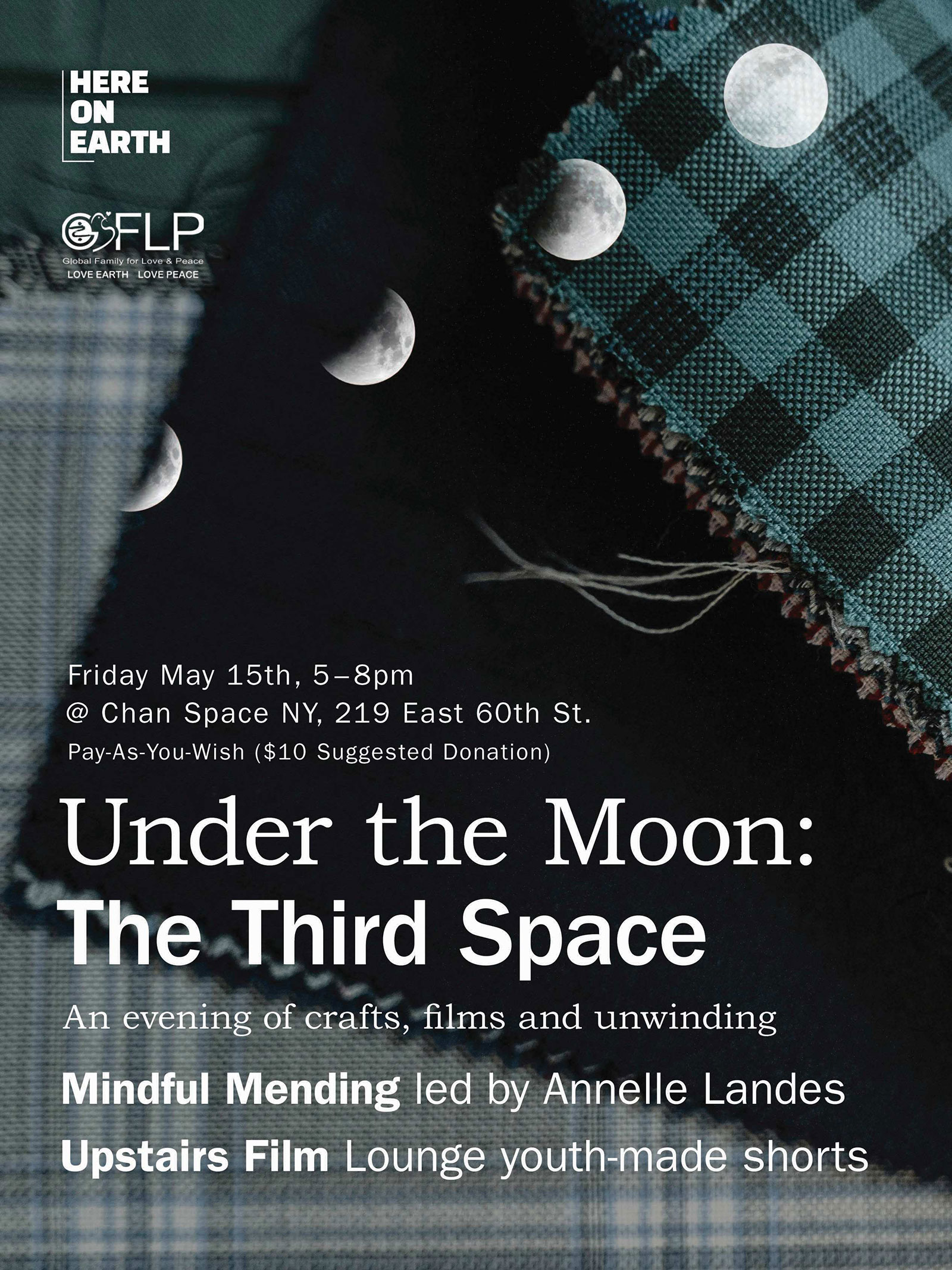
Lu Chih-Lan, Director of Education and Training at GFLP, stated that the participants are extending their insights into pollution through tangible action. During the "Walking Under the Moon" event on May 15, they will transform the LJM New York Zen Space into a non-consumptive "Third Space." This sanctuary will bridge environmental consciousness with daily life, allowing people to socialize freely and calibrate their mind and body, thereby re-establishing connections with themselves and others to rediscover inner tranquility.
Lu further emphasized that film is more than a mere record; it is a lens through which youth scrutinize environmental complexities. The "Climate! Film! Action!" project empowers students to transform subtle daily observations into matters of public discourse—from urban spatial layouts to the distribution of public infrastructure—demonstrating how environmental shifts reshape the individual and collective psyche. Through these unique youthful perspectives, the initiative aims to infuse environmental advocacy with a layer of profound humanistic depth.
Beyond cultivating filmmaking skills, the "Climate! Film! Action!" program prioritizes empowering participants to address pressing real-world challenges. Under this initiative, film serves as a vital bridge connecting personal lived experiences with public discourse. This process enables students to evolve from mere "observers" into "active agents of change" who participate in public dialogue, infusing contemporary environmental issues with a vibrant and hopeful youthful energy.
At the Youth Action 50 Summit in early May, members of the "Climate! Film! Action!" project explored the theme of "Pollution" through a multi-dimensional lens. Their investigations spanned from mental landscapes and public space litter to air quality and the vital contributions of informal community waste picking systems to resource recovery. Furthermore, they examined grassroots initiatives like the Billion Oyster Project, observing how oyster reef restoration serves as a practical model for rehabilitating aquatic ecosystems.
Beyond addressing traditional environmental degradation, members further observed that pollution is reshaping both our quality of life and holistic well-being. As public spaces shrink and natural sanctuaries are increasingly supplanted by commercial venues, the areas where people can freely linger, reflect, and find emotional equilibrium are diminishing. This loss negatively impacts mental health, giving rise to a subtle yet pervasive form of "mental pollution." With May being National Mental Health Awareness Month, presenting these findings now underscores a vital truth: pollution affects not only our physical surroundings but also our internal state, calling for a more profound public discourse on the intersection of environment and mind.
At the summit, "Climate! Film! Action!" participants showcased five short films centered on the theme of pollution. Through interactive display boards, they shared the creative inspiration and context behind each work. By combining documentary footage with evocative photography, the students illustrated urban dynamics and environmental phenomena, effectively mapping the symbiotic relationship between humanity and nature. This approach allowed attendees to engage with abstract issues through grounded, tangible scenarios, sparking meaningful dialogue and transforming the environmental insights of the new generation into a potent force for civic action.
From Corporate Accountability to Community Engagement: Environmental Advocacy Gains Recognition
Officials from the New York City Department of Sanitation engaged with the participants to explore their perspectives on pollution issues. Waverly, a high school student, used a potato chip bag as a compelling example, arguing that manufacturers must bear environmental accountability for the low-cost convenience they provide. Representing the group, she proposed that environmental policies should integrate community engagement frameworks, establishing bidirectional communication channels tailored to localized issues—such as flooding or noise pollution—to ensure a precise response to local needs. Impressed by these nuanced insights, the officials requested copies of the films for internal reference and encouraged the members to participate in the Youth Climate Summit, continuing to leverage visual media to catalyze public environmental awareness.
Reclaiming the Vanished "Third Space": Reconnecting Humanity Through the "Walking Under the Moon" Initiative
An audience member originally from Montana—a state renowned for its pristine, untamed landscapes—was deeply resonated by Sydney’s film, "What the Town Mouse Needs." The work, which explores the loss of the "Third Space," prompted him to share his own experience: moving to New York meant being severed from nature’s embrace. Far from the grounding presence of greenery, he found it increasingly difficult to feel at ease, describing a persistent inner tension and a loss of grounding. His poignant reflection mirrored a universal struggle in modern urban life—the growing alienation between humanity and the natural world.
Lu Chih-Lan, Director of Education and Training at GFLP, stated that the participants are extending their insights into pollution through tangible action. During the "Walking Under the Moon" event on May 15, they will transform the LJM New York Zen Space into a non-consumptive "Third Space." This sanctuary will bridge environmental consciousness with daily life, allowing people to socialize freely and calibrate their mind and body, thereby re-establishing connections with themselves and others to rediscover inner tranquility.
Lu further emphasized that film is more than a mere record; it is a lens through which youth scrutinize environmental complexities. The "Climate! Film! Action!" project empowers students to transform subtle daily observations into matters of public discourse—from urban spatial layouts to the distribution of public infrastructure—demonstrating how environmental shifts reshape the individual and collective psyche. Through these unique youthful perspectives, the initiative aims to infuse environmental advocacy with a layer of profound humanistic depth.
Beyond cultivating filmmaking skills, the "Climate! Film! Action!" program prioritizes empowering participants to address pressing real-world challenges. Under this initiative, film serves as a vital bridge connecting personal lived experiences with public discourse. This process enables students to evolve from mere "observers" into "active agents of change" who participate in public dialogue, infusing contemporary environmental issues with a vibrant and hopeful youthful energy.